
Somewhere in your organization right now, there’s a folder. Inside that folder is a document titled something like “Data Privacy Policy — FY2023” or “Compliance Framework v2.1.” Someone spent weeks writing it. Legal signed off on it. The board approved it in a meeting that ended with handshakes.
And then nobody looked at it again.
That document — that PDF, that policy, that carefully worded framework that nobody reads after the approval email — is what most NBFCs and fintechs are counting on to keep them compliant with the DPDP Act 2023. And honestly? That’s terrifying.
Not because the document is wrong. But because a document can’t do anything. It can’t see what your DSA partner did with customer data last Thursday. It can’t flag that a bulk SMS campaign just went out without a valid consent record attached. It can’t alert your DPO that someone submitted a deletion request four days ago and the 7-day SLA clock is already running. It can’t hand the DPBI inspector a complete evidence pack when they show up unannounced.
A document sits there. That’s all it does.
And in 2025, with India’s Data Protection Board of India now operationally active and penalties under Section 8 going up to ₹250 crore, “we had a policy in place” isn’t a legal defense. It’s barely even a sentence. The era of static compliance is over. The era where you must watch, measure, and respond in real time has started. Whether organizations are ready for it or not.
The Honest Problem with Static Compliance
Here’s the thing about static compliance that nobody really says out loud: it was always a workaround. Not a solution.
The whole model — do the gap assessment, wrote the policies, ran training, file the certificate, done — made a kind of sense when regulations updated slowly, inspections happened rarely, and the volume of personal data being processed was small enough that a spreadsheet could theoretically track it. None of those conditions exist anymore.
A mid-sized NBFC today is processing tens of thousands of loan applications every single month. Each application touches Aadhaar numbers, PAN cards, bank statements, bureau data, device identifiers. Every DSA partner in the network is handling some portion of that data under their own practices. Every integration with a credit bureau, a BNPL partner, or an Account Aggregator is a potential liability point under Section 8(2). Every consent captured through your loan origination system either meets Section 6’s standard — one purpose, one checkbox, no bundling — or it doesn’t.
There is no quarterly audit cycle on earth that catches violations at this speed and this scale. There is no annual policy review that keeps pace with this volume. The failure isn’t intent. The failure is infrastructure. Organizations that genuinely want to be compliant are using tools that were built for a completely different world.
Static policies don’t fail because they’re dishonest. They fail because they’re blind.
What Continuous Monitoring Actually Means in Practice
The foundation of real-time compliance is continuous monitoring. Which sounds obvious when you say it — of course you should be monitoring continuously. But the gap between saying it and doing it is enormous for most organizations.
Continuous monitoring means you’re not taking a compliance photograph once a quarter and calling it a health check. You’re watching the live feed. At any given moment, you know what data is being processed, by whom, under what lawful basis, with which consent records back it up. You know how many DSAR requests are currently open and exactly how many days are left on each SLA. You know whether your downstream processors have logged any potential breach events in the last 72 hours.
Think about it this way: there’s a difference between a smoke detector and a fire marshal who checks the building on the last Friday of every month. Both are technically doing fire prevention. But only one of them catches the fire while it’s still small.
Right now, if someone asked most NBFCs and fintech those monitoring questions — how many consent records are active, how many have been withdrawn, have those withdrawals propagated to all processors — they’d start an email chain. That email chain would take three days minimum. By the time it resolves, the DPBI window has closed, the SLA has breached, and the liability is already established.
The gap between what’s happening and what you know is happening — that gap is exactly where DPBI penalties are born.
Live Scoring: Why Compliance Needs a Number
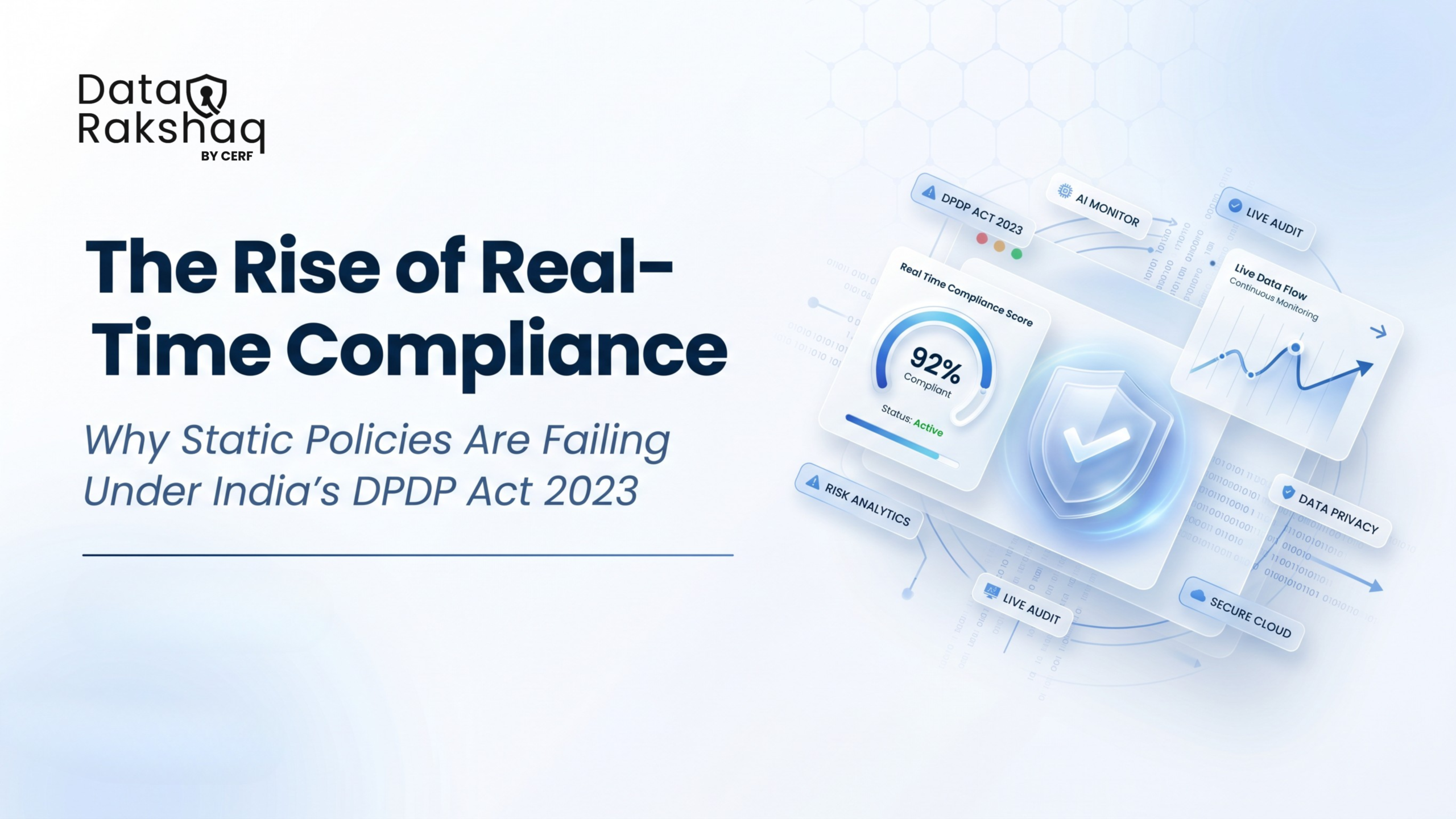
One of the quietest but most powerful ideas in real-time compliance is giving the whole thing a score. A live, continuous, 0–100% number that reflects your actual compliance posture at this moment — not last quarter, not when someone last ran the audit.
A live compliance score does something that a policy document fundamentally cannot: it tells you when something changes. If your score is 87% on Monday morning and 71% by Thursday evening, something happens. A new processing activity went live without a corresponding RoPA entry. A consent profile wasn’t updated when the product team shipped a new feature. A vendor agreement lapsed and nobody flagged it. The score doesn’t just show you where you are. It points to where you need to look.
This matters way beyond the legal and compliance team. When a live score is visible to product managers, engineering leads, and business heads, compliance stops being someone else’s problem. When the product team’s LOS widget update drops the score by 4 points, they see it. They feel it. That’s how compliance stops being a paperwork exercise and starts being a culture — because it’s embedded into the daily workflow, not appended to it at the end of a quarter.
It matters for board too, maybe more than anything else. A board reviewing static compliance report once every three months is making governance decisions based on data that was already aging when it was printed. A board that can pull a live report in 10 seconds — with checkpoint-level detail, with a clear score, with drill-down on what’s green and what isn’t — is governing. That’s a completely different conversation.
Dynamic Compliance: Keeping Pace with a Regulation That’s Still Evolving
Here’s something that doesn’t get talked about enough: the DPDP Act 2023 is not a finished regulation. It’s an active one. The rules are still being notified. Sector-specific guidance is still emerging. The DPBI is still establishing enforcement precedents. Any compliance framework that was built in 2023 and hasn’t been updated since is, by definition, operating on a partial picture.
Dynamic compliance is about the framework moving with the regulation. When the DPBI issues a new guidance note, when RBI drops a circular that intersects with data processing obligations around credit bureau flows, when new rules clarify something that was previously ambiguous — a dynamic compliance platform incorporates those changes within a defined window and reflects them in your audit checkpoints. Your RoPA gets updated. Your lawful classifications get flagged for review where needed. You don’t need a task force. You don’t need a fresh gap assessment. The platform absorbs the change and tells you what to look at.
This is especially important for NBFCs and fintechs, which are always sitting at the intersection of at least two major regulatory regimes — the DPDP Act and RBI’s directions. A GDPR-originated GRC tool has no idea what a DSA network means. It doesn’t understand that credit bureau flows have specific legitimate-use carve-outs under Section 7. It doesn’t know how Account Aggregator data sharing creates layered consent obligations that don’t exist in European data law.
Real dynamic compliance isn’t just about updating checkpoints. It’s about understanding the sector deeply enough to know which checkpoints matter and why.
How DataRakshaQ by CERF Was Built for This Exact Problem
CERF Global Services built DataRakshaQ on a single, clear-eyed premise: DPDP compliance for Indian NBFCs and fintechs is not a documentation challenge. It’s an operational challenge. And you solve an operational challenge with an operational platform, not a better template.
DataRakshaQ wasn’t retrofitted from a generic GRC tool after the DPDP Act came into force. It was built from scratch for DPDP Act 2023 compliance — with pre-loaded RoPA libraries, NBFC-specific consent profiles, and evidence packs that generate in seconds. There’s a meaningful difference between a platform that understands what a DSA network is versus one that has never heard of it.
On continuous monitoring — the breach detection and response module integrates with your SIEM in real time. The moment a potential breach event is flagged, two timers start simultaneously: the 72-hour DPBI notification window and the 6-hour CERT-In notification window. Auto-escalation kicks in. Pre-filled notifications are ready to go. Nobody is manually tracking timers on a spreadsheet. Nobody is waking up to find they missed a deadline by three hours. The system watches constantly, so your team can focus on running the business instead of watching the clock.
On live scoring — the audit module runs across 92 checkpoints continuously. Your compliance score is always current. When a checkpoint fails, you see it immediately. When it’s resolved, the score reflects that too. And when you need to present it to the board, the report takes 10 seconds to generate. Not 10 working days. Not “we’ll have it ready by next week.” Ten seconds.
On dynamic compliance — DataRakshaQ commits to incorporating regulatory updates within 10 working days of notification. When the DPBI issues fresh guidance, when RBI intersects with data obligations, when the rules under the Act are formally notified — the platform updates before your next review cycle. You’re never unknowingly running on a framework that’s already been superseded.
On consent — this is where static compliance collapses fastest. Under Section 6, consent must be granular. One purpose, one checkbox. No bundling. Freely given, specifically, and informed. A consent clause buried in a PDF terms document does not meet this standard — full stop. DataRakshaQ captures consent at the purpose level, runs it through S.6 validity scoring, stores it as a SHA-256 tamper-proof record, and enforces a 24-hour withdrawal SLA. If a Data Principal withdraws consent, that withdrawal propagates downstream automatically. The consent ledger is always live — it shows what consent looks like right now, not what it looked like when the customer signed up two years ago.
On data discovery — you cannot monitor what you haven’t mapped first. DataRakshaQ’s data discovery and RoPA module runs enterprise-wide PII detection across 45 pre-loaded processing activities built specifically for BFSI. Aadhaar and PAN regex matching. Data flow mapping. Lawful basis classification. This isn’t a blank register you fill in from scratch. It’s operational from activation. You’re not starting from zero.
On DSAR rights — Sections 11 and 12 give Data Principals the right to access, correction, and erasure, with a 7-day response SLA. DataRakshaQ’s rights portal gives Data Principals structured forms across 6 request types, auto-acknowledges within 48 hours, tracks every SLA to the hour, and propagates erasure to all downstream processors. The SLA isn’t a target. It’s enforced by the system.
The full compliance journey — from initial gap assessment to being genuinely DPBI inspection-ready — takes 16 weeks through a structured, milestone-based program. At the end of it, a DPBI inspector can walk into your office and have a complete evidence pack in 90 seconds. Not a folder of scrambled documents assembled under pressure overnight. 90 seconds.
What Staying Static Actually Costs You
Some organizations will still make arguments for handling it internally. “We’ll use existing tools. We’ll manage the documentation. We’ll cross that bridge when we come to it.”
It’s worth just being direct about what that looks like when the bridge arrives.
A manual compliance plan built on Word documents will not survive a DPBI inspection. When a complaint is received, the organization has 72 hours to produce evidence. Not a summary document. Not a well-written explanation. Evidence — consent logs, processing records, breach timelines, DSAR status, lawful basis documentation, all of it. If that evidence doesn’t exist in a structured, retrievable format, the board is liable. Not “potentially liable.” Liable.
A bulk SMS sent without a DPDP-valid consent record is a Section 6 violation. Maximum penalty: ₹250 crore. A vendor data breach with no processor controls is a Section 8(2) event. Under CERT-In requirements, the 6-hour notification window starts the moment the breach is detected — and every hour without an automated alert system is an hour your team is chasing information instead of filing notifications.
The cost of getting this wrong isn’t just the fine on paper. It’s the reputational damage that follows a public DPBI action. It’s the board-level exposure that comes with personal liability. It’s the operational chaos of trying to reconstruct three years of compliance evidence in 72 hours while running a business.
Real-time compliance isn’t a premium add-on for organisations with big budgets. It’s the minimum viable posture for anyone who wants to keep operating safely in India’s current regulatory environment.
Conclusion: Compliance Is Not Something You File. It’s Something You Do Every Day.
The organizations that come through India’s DPDP Act era without significant exposure won’t be the ones with the thickest policy binders. They’ll be the ones that made compliance a living, operational part of how they work — monitored continuously, scored in real time, governed by actual current data, and updated as the regulation itself evolves.
Static policies had their time. That time is genuinely over. The DPDP Act has created an environment where the only way to be truly compliant is to know, right now, at this moment, where you stand — and to have the evidence to prove it the moment anyone asks.
The gap between where most organizations are and where they need to be is real. But it’s closeable. With the right platform, with a structured program, in a defined timeframe. That’s exactly what DataRakshaQ by CERF Global Services was built to do — not to help your paper over the gaps, but to close them.
In a world where the DPBI can walk in today and ask for evidence in 90 seconds, the real question isn’t whether you can afford real-time compliance. It’s whether you can afford to keep pretending that a shared folder with a policy document is close enough.
It isn’t. And somewhere, you already know that.
Copyright @2025 CERF Solutions Pvt Ltd. All Rights Reserved. Terms and Conditions | Privacy Policy
 QR
QR