
India’s financial sector is under more regulatory pressure than ever before. The DPDP Act 2023, RBI’s data governance directives, and CERT-In’s breach notification rules have all raised the bar — at the same time.
And yet, most NBFCs and fintech are still running on compliance frameworks built for a different era.
Static policy documents. Annual audits. Spreadsheet-based registers. These tools were designed for a world that no longer exists. They cannot keep pace with the speed at which data moves, regulations evolve, and risk accumulates.
This article explains why the old model is failing — and what real-time compliance actually looks like in practice.
Picture this. A Data Protection Board inspector walks into your office. They ask one question: “Show us your current compliance posture.”
If your answer involves opening a folder, assembling documents, or calling your compliance team to pull together evidence — you already have a problem.
Static compliance gives you a snapshot. It tells you where you stood on the day someone last updated a spreadsheet or filed a report. It says nothing about where you stand right now.
In the DPDP era, the difference between “then” and “now” is the difference between passing an inspection and facing enforcement action.
Think about everything a mid-sized NBFC processes on a typical business day.
Loan origination systems pull bureau data. DSA networks gather borrower information across dozens of touchpoints. Marketing engines send bulk SMS and email campaigns to hundreds of thousands of Data Principals. BNPL workflows create consent events at every checkout.
Every single one of these is a compliance event under the DPDP Act. Each one carries legal exposure. And each one happens far faster than any policy document can be updated to reflect it.
What you need is not better documentation. You need a centralized consent collection platform that tracks every event the moment it happens.
Regulators are not looking for polished policy manuals. They want evidence — timestamped, tamper-proof, and auditable.
They want proof that your organization was compliant at the precise moment a transaction occurred, a consent was captured, or a breach was first detected.
Static documents cannot produce that proof. A real-time DPDP consent record management system can. But only if it is built to capture and store evidence continuously — not scrambled together after the fact.
Annual audits create a false sense of security. Between one audit and the next, a lot can go wrong.
A new vendor agreement may introduce data processing obligations you have not classified. A marketing campaign may bundle consents in violation of Section 6. A processor relationship may lack the security controls the law requires.
None of these risks announce themselves. A static compliance framework will not catch them either. A live compliance score will — the moment they appear.
The organizations that sail through regulatory scrutiny are not always the ones with the thickest policy manuals. They are the ones who can answer this question at any moment: “What is our compliance posture right now?”
They know which data processing activities are active. They know which consents are valid. They know whether any breach timers are running. They do not scramble to find this information — because the system always has it, continuously updated and ready to present.
This is dynamic compliance. Not a philosophy — an operational architecture.
Live scoring replaces point-in-time audits. Continuous monitoring replaces manual reviews. Automated evidence generation replaces document assembly. The result is an organization that is not just compliant on paper, but provably compliant in practice — every day, every hour, every transaction.
DataRakshaQ is CERF’s purpose-built data privacy platform for India’s NBFCs and fintech. It was designed from the ground up for the DPDP Act 2023 — not adapted from a generic GRC tool. Every feature reflects the specific data flows, processing patterns, and compliance obligations of regulated financial institutions in India.
Here is how it works.
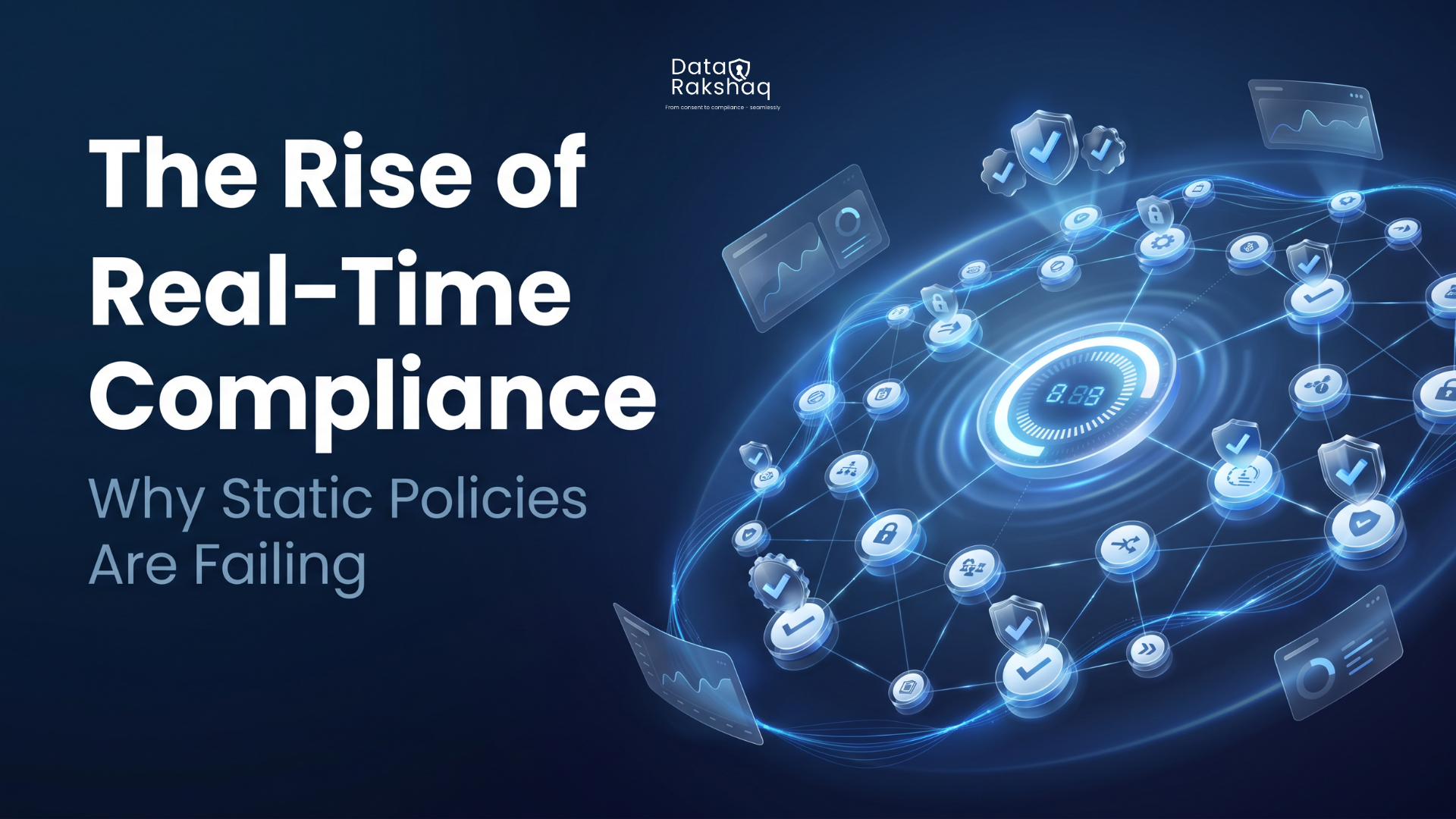
DataRakshaQ gives you a live 0–100% compliance score, updated continuously across 92 audit checkpoints.
This is not a quarterly self-assessment. It is a real-time reflection of your actual operational state — your consent records, processing activities, security controls, vendor relationships, and breach readiness, all scored together.
When a gap opens anywhere in that picture, the score moves immediately. Your compliance team sees what changed, understands the source, and can act before it becomes a liability. That is what continuous monitoring looks like in practice.
Most compliance tools treat consent as a checkbox. The DPDP Act does not — and neither does DataRakshaQ.
Every consent captured through the platform is validated for Section 6 compliance at the moment of collection. Purpose-level granularity. No bundling. Free, specific, and informed. SHA-256 hashing ensures that no record can be altered after the fact, giving you a tamper-proof DPDP consent audit trail from day one.
Consent withdrawal is enforced by the system, not by memory. When a Data Principal exercises their right to withdraw, a live 24-hour timer starts automatically. Erasure instructions are propagated to downstream processors without manual intervention. Every step is documented and auditable.
From first capture to final withdrawal, DataRakshaQ manages the complete consent lifecycle — so nothing slips through the cracks.
The DPDP Act requires you to notify the DPBI within 72 hours of detecting a breach. CERT-In requires notification within 6 hours for certain incident categories.
In a static compliance environment, someone sets a reminder, sends an email chain, and hopes no one drops the ball.
DataRakshaQ runs both timers automatically from the moment a breach is detected — through real-time SIEM integration. Auto-escalation workflows route the right people to the right actions at the right time. Pre-filled notification templates remove the delay of drafting under pressure. The breach register updates itself throughout.
There is no manual tracking. There are no missed deadlines.
Pulling together evidence for a regulatory inspection used to take weeks. Teams would be pulled away from their regular work. Spreadsheets, shared drives, and email archives would be combed through. It was expensive, stressful, and entirely avoidable.
DataRakshaQ eliminates that process. The DPBI Evidence Pack — everything an inspector needs to assess your compliance posture — is generated in 90 seconds. The Board Report, structured for board-level governance, is ready in 10 seconds.
These are not exports of pre-staged data. They are live documents, generated on demand, reflecting your organization’s actual state at the moment you request them.
That changes everything about how you approach regulatory scrutiny. Instead of bracing for an inspection, you can walk into one with confidence.
Maintaining a Records of Processing Activities register manually is one of the most time-consuming parts of DPDP compliance. Tracking every processing activity, classifying lawful bases, mapping data flows, managing processor relationships — it is a significant ongoing burden.
DataRakshaQ comes pre-loaded with 45 processing activities configured specifically for BFSI contexts. Loan origination. Bureau queries. DSA networks. BNPL flows. Account opening. Fraud detection. These are not blank templates. They are ready to use from activation, with lawful basis classifications already assigned.
As your operations evolve, the RoPA evolves with them — updated continuously, not once a year.
The DPDP Act does not reward good intentions. It rewards demonstrable, current, evidence-backed compliance — the kind that exists right now, not the kind that existed when someone last updated a document.
Static policies and annual audits had their place. That place was a regulatory environment that no longer exists in India.
The NBFCs and fintech that will lead through the coming period of DPBI enforcement are the ones that have already made the shift. They have live scores. They have ready evidence. They know their posture at any given moment — and they can prove it.
At CERF Solutions, we built DataRakshaQ because compliance should be an operational strength, not an administrative burden. Every feature — from the 92-checkpoint live score to the 90-second evidence pack, from the dual breach timers to the SHA-256 consent ledger — is built to give your organization the reality of compliance, not just the appearance of it.
Every day. Every hour. Every transaction.
Copyright @2025 CERF Solutions Pvt Ltd. All Rights Reserved. Terms and Conditions | Privacy Policy
 QR
QR