
The Digital Personal Data Protection (DPDP) Act, 2023 marks a significant shift in India’s approach to personal data governance. For NBFCs, fintech companies, banks, insurance providers, healthcare organizations, and enterprises handling personal data, compliance is no longer just a legal obligation—it is a business necessity.
Despite this, many organizations continue to postpone their DPDP Act compliance initiatives.
“We’ll begin after our next product launch.”
“We’re waiting for the implementation rules.”
“We’ll focus on compliance next quarter.”
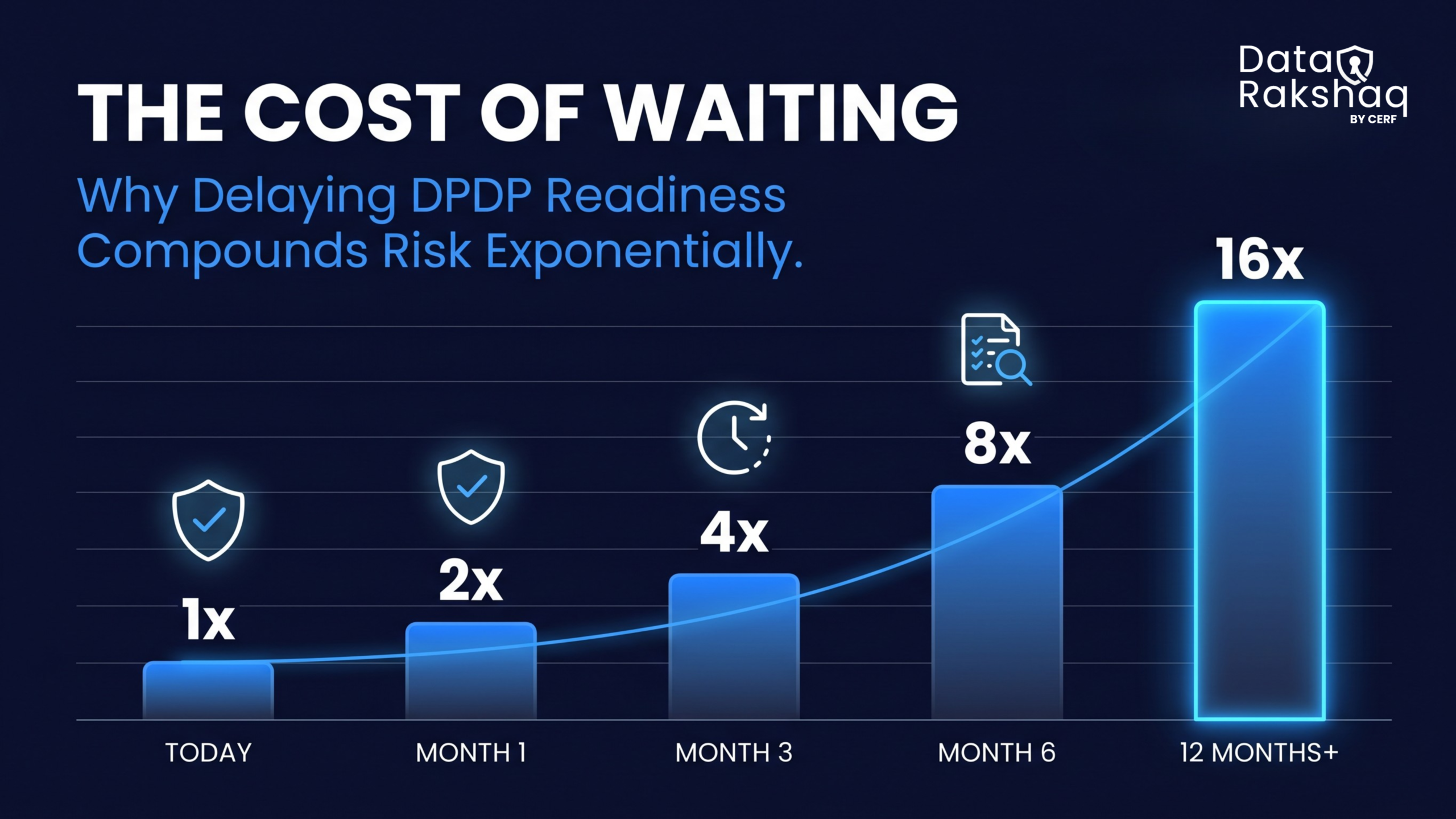
While these decisions may seem practical in the short term, every delay silently increases operational complexity, compliance gaps, and regulatory exposure.
The truth is simple: the longer you wait, the more difficult and expensive compliance becomes.
Think of DPDP Act compliance as maintaining financial discipline.
Ignoring a small debt today doesn’t make it disappear—it grows with interest. The same principle applies to compliance.
Every day your organization processes personal data without complete governance, you accumulate compliance debt.
This includes:
Individually, these gaps may seem minor.
Collectively, they create significant regulatory and operational risks that become increasingly difficult to address over time.
Many organizations believe postponing compliance saves time and resources.
In reality, it often creates more work.
As businesses grow, so does the volume of personal data they collect and process. Every new customer, mobile application, marketing campaign, employee record, and vendor relationship introduces additional compliance responsibilities.
If these activities are not documented as they happen, organizations eventually face the daunting task of reconstructing months—or even years—of compliance evidence.
Instead of building a structured privacy program, teams are forced into reactive exercises involving spreadsheets, emails, and manual documentation.
This approach is time-consuming, inefficient, and highly prone to errors.
The biggest compliance risks rarely begin with large-scale security incidents.
They usually start with routine business activities.
Imagine these common scenarios:
A marketing campaign is launched without maintaining valid, purpose-specific consent required under the DPDP Act.
A customer requests the deletion of their personal information, but the organization cannot identify every system where that data resides.
A third-party processor experiences a data breach, exposing customer information without adequate contractual safeguards.
A regulator requests Records of Processing Activities (RoPA), but documentation is scattered across departments with no centralized audit trail.
Each of these situations creates unnecessary compliance challenges that could have been prevented through proactive governance.
Organizations often assume they can prepare documentation once regulators ask for it.
Unfortunately, regulatory investigations don’t work that way.
A customer complaint.
A personal data breach.
A vendor incident.
An internal whistleblower.
Any one of these events can trigger regulatory scrutiny.
When that happens, organizations must quickly demonstrate:
Organizations relying on manual documentation may spend weeks collecting this information.
Organizations with automated governance systems can generate the same evidence within minutes.
Managing DPDP Act compliance using spreadsheets and documents may seem manageable initially, but it becomes increasingly difficult as organizations expand.
Manual processes often result in:
Modern compliance requires continuous monitoring rather than periodic documentation.
Automation has become essential for maintaining long-term compliance.
Successfully implementing the DPDP Act requires more than policies and documentation. Organizations need a structured framework, domain expertise, and technology that can transform compliance into an ongoing business process.
This is where CERF and DataRakshaQ work together.
CERF Global Services combines regulatory consulting, privacy expertise, and implementation support to help organizations understand their obligations under the DPDP Act. From conducting gap assessments and defining governance frameworks to developing compliance roadmaps, CERF enables organizations to build a strong foundation for privacy compliance.
Complementing this expertise, DataRakshaQ serves as a comprehensive DPDP compliance platform designed to automate and simplify privacy operations.
Together, CERF and DataRakshaQ help organizations:
Rather than relying on fragmented manual processes, organizations gain a structured and scalable approach to compliance that evolves alongside their business.
Unlike generic governance platforms, DataRakshaQ is purpose-built for DPDP Act compliance.
It helps organizations centralize every critical aspect of privacy management within a single platform.
With DataRakshaQ, organizations can:
Continuously update processing activities as business operations evolve, ensuring RoPA remains accurate and audit-ready.
Capture, validate, manage, and withdraw customer consent with complete audit trails aligned with the DPDP Act.
Efficiently process requests for access, correction, nomination, grievance redressal, and erasure through automated workflows.
Track vendor relationships, contractual obligations, and processor accountability under the DPDP Act.
Coordinate breach management, maintain documentation, and support timely regulatory reporting.
Create reports, dashboards, and compliance documentation in minutes instead of spending days compiling evidence manually.
Organizations that embrace the DPDP Act gain more than legal compliance.
They establish stronger governance, improve operational efficiency, enhance customer confidence, and build a reputation for responsible data management.
Privacy has become a competitive advantage.
Customers increasingly prefer organizations that demonstrate transparency and accountability in how they manage personal information.
Compliance is no longer simply about avoiding penalties—it is about building long-term trust.
Every new customer.
Every new employee.
Every new digital service.
Every new processing activity.
Each one increases the amount of personal data your organization is responsible for protecting.
Delaying DPDP Act compliance doesn’t reduce this responsibility—it compounds it.
The longer organizations wait, the more difficult it becomes to reconstruct records, validate consent, map data flows, and establish governance.
The gap between what an organization believes it can prove and what it can actually demonstrate continues to grow.
The DPDP Act represents a new era of data governance in India.
Organizations that begin their compliance journey today will be better positioned to respond to regulatory requirements, strengthen customer trust, and reduce operational risk.
With the combined expertise of CERF Global Services and the automation capabilities of DataRakshaQ, organizations can move beyond reactive compliance and build a sustainable, scalable privacy program designed for long-term success.
The question is no longer whether your organization needs to comply with the DPDP Act.
The real question is whether you’ll prepare proactively—or wait until you’re asked to prove it.
Copyright @2025 CERF Solutions Pvt Ltd. All Rights Reserved. Terms and Conditions | Privacy Policy
 QR
QR