
Every Chief Data Officer has seen it before.
A dense spreadsheet hidden inside a compliance folder with a name like:
“Record of Processing Activities – FY2025 – FINAL_v3_revised.xlsx.”
It gets updated once a year — usually right before an audit. After that, nobody opens it again.
This is where most Indian enterprises are getting RoPA wrong.
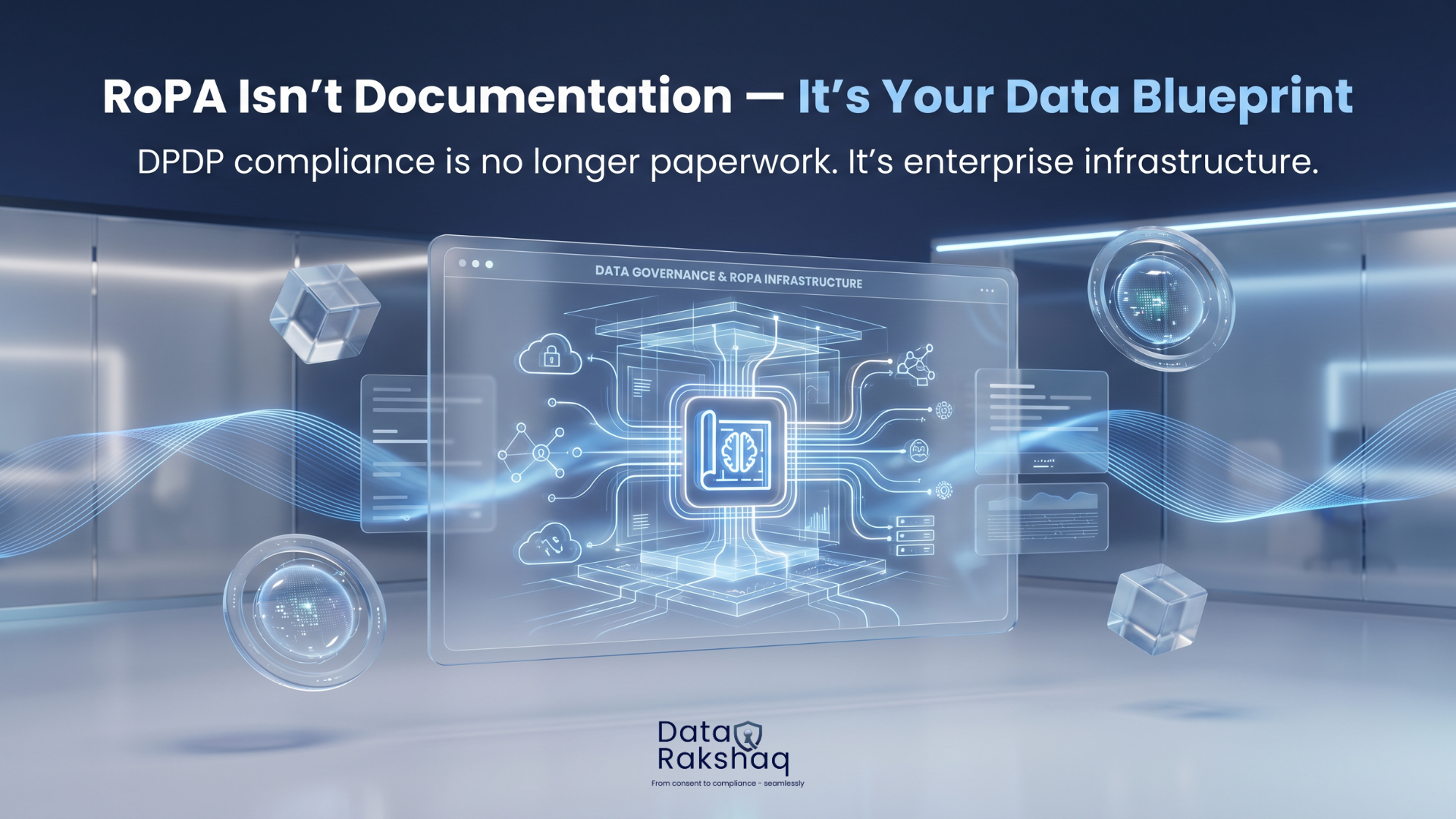
The problem is not that organizations don’t maintain a Record of Processing Activities (RoPA). The problem is that they treat it as a compliance document instead of what it actually is — a blueprint of their entire data ecosystem.
Under India’s DPDP Act 2023, RoPA is far more than paperwork. It is a living map of how personal data moves through your organization:
That is not just compliance information.
That is business intelligence.
Organizations that understand this are building stronger data governance, cleaner data infrastructure, and long-term competitive advantages.
When the DPDP Act 2023 was introduced, most organizations reacted in the usual way.
Legal teams received the responsibility.
Legal passed it to IT.
IT created spreadsheets.
The organization moved on.
The goal became simple:
“Be ready if the Data Protection Board of India asks questions.”
That reaction is understandable.
The penalties under the DPDP Act are significant. Section 8 violations can attract penalties up to ₹250 crore. Missing consent audit trails can compress response windows to 72 hours. Vendor breaches under Section 8(2) can trigger simultaneous DPBI and CERT-In obligations.
No leadership team wants to explain those failures in a board meeting.
But there is a major difference between:
One gives you files.
The other gives you visibility, control, and decision-making power.
The organizations gaining the most value from DPDP compliance are not doing more work. They are simply using compliance data more intelligently.
A modern RoPA built on an automated DPDP consent management platform in India provides much more than regulatory records.
It creates visibility across the organization.
A strong RoPA identifies every department, vendor, and downstream processor handling personal data.
For NBFCs and BFSI enterprises, this often reveals something surprising:
Leadership teams usually underestimate how many external entities handle customer PAN details, Aadhaar data, bureau records, and KYC information.
Every processing activity must be linked to a lawful basis:
When enterprises map this properly, they often discover that several processing activities have no clear legal justification.
The organization continued collecting data simply because it always had.
Retention mapping exposes hidden data accumulation.
Loan application records remain stored years after use.
Archived databases continue holding personal data indefinitely.
Legacy systems preserve information no one actively manages.
Over time, this silent accumulation becomes both a regulatory and operational risk.
Data flow mapping reveals:
Many organizations discover integrations their current teams did not even build.
RoPA brings those hidden data flows into visibility.
And that visibility creates control.
The real value of RoPA comes from asking better questions.
Most organizations ask:
“Have we documented our processing activities?”
Better organizations ask:
“Which processing activities create the highest regulatory risk compared to business value?”
Instead of:
“Do we have consent records?”
Ask:
“Where are customers dropping off during consent collection, and what revenue impact does that create?”
Instead of:
“Have we documented vendors?”
Ask:
“Which vendor relationships create concentration risk in our data supply chain?”
This shift changes RoPA from a compliance register into a strategic intelligence framework.
At CERF Global Services, we have worked with enterprises across government, telecom, healthcare, fintech, e-commerce, BFSI, and NBFC sectors.
The pattern is consistent.
The organizations that succeed with data are not the ones collecting the most information.
They are the ones managing data with the highest level of discipline.
That means:
The DPDP Act 2023 is not introducing a completely new responsibility.
It is formalizing what enterprises should already have been doing:
Treating customer data as a trusted asset.
Organizations that view DPDP compliance as a burden will spend years reacting to audits, complaints, and remediation projects.
Organizations that treat compliance as infrastructure investment will build long-term advantages:
RoPA is not where compliance ends.
It is where enterprise data strategy begins.
Manual RoPA management cannot support modern enterprise requirements.
Static spreadsheets become outdated immediately.
Manual documentation cannot answer urgent questions quickly.
Compliance teams struggle to generate evidence during investigations.
DataRakshaq was built specifically to solve this challenge.
It is not a generic global GRC tool adapted for India.
It is a DPDP Act 2023-native consent management platform designed specifically for Indian enterprises.
DataRakshaq includes:
The platform already supports:
This dramatically reduces implementation complexity.
The platform enables:
Consent is no longer reconstructed during audits.
It becomes continuously measurable and verifiable.
DataRakshaq maintains immutable audit trails and generates inspection-ready evidence in seconds.
When DPBI timelines begin, organizations are already prepared.
The platform supports:
The system simultaneously tracks:
This removes manual tracking risk during high-pressure breach situations.
Organizations operating RoPA as live infrastructure consistently unlock business value beyond compliance.
Most enterprises store significantly more personal data than necessary.
Automated visibility helps eliminate redundant storage, reduce exposure, and lower operational costs.
Purpose-specific, transparent consent often correlates with:
Consent quality becomes a measurable business metric.
RoPA mapping helps identify:
Issues become visible before they become expensive.
For organizations using manual compliance systems, a DPBI notice creates panic.
For organizations using automated infrastructure, it becomes a managed workflow.
That difference is not about intent.
It is about architecture.
RoPA is ultimately a reflection of organizational discipline.
It reveals:
Most organizations discover uncomfortable realities during their first serious RoPA exercise.
That is normal.
The important question is not whether gaps exist.
The important question is whether the organization is willing to fix them.
The future leaders of India’s digital economy will not simply be the organizations with the most data.
They will be the organizations with the cleanest and most trusted data foundations.
The DPDP Act 2023 is forcing enterprises to rethink how they manage personal data.
RoPA sits at the center of that transformation.
When treated as documentation, it satisfies compliance requirements.
When treated as infrastructure, it becomes a strategic advantage.
That is why enterprises need more than spreadsheets and fragmented workflows.
They need integrated, automated, India-specific compliance infrastructure.
DataRakshaq is built for that purpose.
A DPDP-native platform designed to help enterprises manage consent, governance, audit readiness, and customer trust at scale.
Because today, the most important question is not:
“Are we compliant?”
It is:
“Can we prove we are in control of our data?”
With DataRakshaq, the answer is yes.
Copyright @2025 CERF Solutions Pvt Ltd. All Rights Reserved. Terms and Conditions | Privacy Policy
 QR
QR