
Let’s start with something uncomfortable.
Most NBFCs are losing borrowers not because their loan products are bad — but because of how they communicate. Or rather, how they don’t.
A prospect fills a form. Three days later, someone calls. An SMS fires from a different system. A field agent sends a WhatsApp manually. And somewhere in that mess, the customer just… disappears. Not because they lost interest. Because the experience felt like nobody was really paying attention.
That’s the real problem. And it’s more common than anyone in the industry likes to admit.
Your borrower’s journey doesn’t follow your org chart
Every internal process deck shows the same clean flow: Lead → Application → Disbursal → Repayment → Renewal. Neat arrows, tidy boxes.
Real life? A customer discovers you through a WhatsApp forward from a cousin. Check your website at midnight. Starts KYC, gets confused at the income proof step, and drops off. Gets rejected by a bank two weeks later. Come back to you. Completes the loan. Misses an EMI during a rough month. Responds to a recovery message because it didn’t feel threatening. Repays. Then refers to his colleague.
That’s not a funnel. That’s a relationship — and it must be treated like one.
Every single touchpoint in that journey is a moment where you either build trust or chip away at it. The question is whether your communication infrastructure is even capable of keeping up.
Why running channels in silos is quietly killing your conversions
Here’s what most NBFCs have: SMS handled by one team, WhatsApp by another, IVR for collections, email for documentation, and a chatbot that’s technically live but nobody’s confident in.
Nobody has a complete view of what any given customer has received, responded to, or ignored. So, the customer gets the same offer three times across different channels. Gets an EMI reminder before their loan has even been disbursed. Gets collections call from someone who has no idea they already clicked the payment link yesterday.
It’s not malicious. It’s just what happens when your communication stack wasn’t built to work as one system.
And in a business built entirely on trust — you’re handling someone’s financial life, after all — that kind of fragmentation doesn’t just hurt efficiency. It hurts your reputation.
The five moments where communication matters
There isn’t a single “NBFC communication strategy.” There are five completely different conversations happening across the borrower lifecycle — and each one needs its own approach.
When you’re trying to get their attention
First impressions in financial services are tricky. Nobody wants to feel sold to, especially about money. Generic bulk SMS campaigns? Mostly ignored. High-frequency calls from unknown numbers? Rejected before they ring twice.
What actually works at this stage is showing up on the right channel with something useful. A WhatsApp message with a quick loan eligibility check. An RCS card that explains your process in plain language. A chatbot that can answer “Do I qualify?” at 11 PM without needing a human in the loop. The goal isn’t to push — it’s to be genuinely helpful before you ask for anything.
When they’re applying and onboarding
This is the stage where most drop-offs happen. And it’s almost never because the borrower changed their mind. It’s because they got confused, felt unsupported, or simply couldn’t figure out what to do next.
Proactive status updates over WhatsApp. Document checklists with clear instructions. Email reminders that actually explain what’s missing and why. These aren’t fancy — they’re just respectful. Borrowers don’t abandon processes they understand. They abandon ones that make them feel lost.
Once the loan is live
After disbursal, most NBFCs go quiet until the EMI is due. That’s a mistake.
This is the window where you build the kind of relationship that turns a one-time borrower into a repeat customer. Not by bombarding them — by being present in low-key, useful ways. A timely EMI reminder on the channel they respond to. A chatbot that can answer a quick balance query without putting them on hold for 12 minutes. The NBFCs that show up well here rarely must spend aggressively on acquisition later.
When repayment goes wrong
Collections are where communication strategy gets genuinely hard. You’re now talking to someone under financial stress. Possibly embarrassed. Very likely avoiding your calls.
The reflex is to escalate — more frequency, more urgency, firmer language. The data consistently says the opposite works better. An IVR that lets someone restructure their EMI at 10 at night, without having to explain themselves to a human agent, performs better than a call center blitz. A WhatsApp message that links straight to a payment option — no guilt trip, just a path forward — recovers more than a threatening letter.
And here’s the thing about collections that isn’t said enough: recovery isn’t just about this EMI. It’s about whether this borrower ever trusts you again. Or warn everyone they know to stay away.
When the loan closes
The borrower who just finished repaying is the warmest lead you’ll ever have. They know your process. They’ve built a history with you. And most NBFCs treat them like strangers.
A personalized message that references their repayment track record. A pre-approved top-up offer on the channel they’ve been most responsive on throughout. This is not difficult — it just requires having the communication data from the entire journey in one place.
What “omnichannel” mean and what it doesn’t
The word gets thrown around constantly, so let’s be precise.
Omnichannel does not mean using a lot of channels. That’s multichannel — and it’s what creates the silo problem described above.
Real omnichannel means every channel knows what happened on every other channel. If a borrower replied to your WhatsApp, the SMS doesn’t go out an hour later. If they clicked the payment link in an email, the collections call doesn’t happen the next morning as if they haven’t got engaged. If they spoke to your IVR yesterday, your chatbot today knows the context.
This level of continuity needs two things: a single platform that connects all channels, and intelligent route that know which channel to use for which borrower at which moment.
Without both, you’re just spending more on outreach and getting worse results.
The compliance piece you can’t ignore
This is India’s NBFC sector in 2025 — you’re operating under TRAI guidelines, RBI’s fair practices code, and increasingly, the DPDP Act 2023. The DPDP Act alone changes what you can do with customer communication data in fundamental ways. Consent management isn’t optional anymore. Audit trails aren’t optional. Data encryption isn’t optional.
An omnichannel platform that was built without compliance in its architecture — not bolted on after the fact — is a regulatory liability waiting to happen. Before you sign with any CPaaS provider, ask them specifically about DPDP readiness, consent management across channels, and message-level logging. If they don’t have clear answers, that’s your answer.
How do you know if it’s working?
Sending messages isn’t the same as communicating. If you’re running omnichannel workflows without measuring the right things, you’re optimizing in the dark. The numbers that tell you something useful:
Which channels drive action at which stage — because what works in lead nurturing is rarely what works in collections. Where exactly in the onboarding journey borrowers go silent — and which channel brings them back. How far in advance an EMI reminder needs to go out on each channel to generate a payment. What percentage of your delinquent portfolio responds to at least one channel — and which one. And what each successful communication is costing you, across all your channel partners combined.
The right platform gives you this visibility. Not just send messages.
Conclusion: In NBFC lending, how you communicate is as important as what you’re offering
India’s credit market is getting more crowded, not less. More NBFCs. More fintech lenders. More channels through which borrowers can find alternatives.
In that environment, your communication quality is a real competitive advantage — possibly more durable than your interest rate, which a competitor can always undercut. The borrowers who feel genuinely looked after throughout their loan journey are the ones who come back. The ones who refer to friends. The ones who don’t leave a scathing review when something goes wrong, because they trust that you’ll sort it out.
Getting there isn’t about adding more channels. It’s about making every channel work together, intelligently, compliantly, and consistently — from the very first message to the last.
How CERFConnect thought about this problem
The honest starting point: most CPaaS platforms were built to help enterprises send messages at scale. CERFConnect was built for something different — control. Because in an industry like NBFCs, scale without control isn’t a feature. It’s a liability.
When the team at CERF was designing CERFConnect, they didn’t begin with channels or features. They began with a question: Why do NBFCs keep losing borrowers despite increasing their communication spending?
The answer they kept arriving at was the same: it’s not volume. It’s coherence. NBFCs have enough tools — they just don’t talk to each other, can’t route intelligently, and weren’t built with financial sector compliance in mind.
Three things shaped everything that went onto the platform.
Ownership over your communication stack. The BYOP — Bring Your Own Partner — model means you’re not locked into CERFConnect’s vendor relationships. If you’ve negotiated good rates with your SMS aggregator or WhatsApp BSP, those relationships stay yours. CERFConnect handles the routing, load balancing, and failover across them. You keep control. They don’t extract margin from every message you send.
Non-technical teams shouldn’t need IT to run a campaign. The no-code drag-and-drop builder — for both campaign flows and chatbot creation — means a collections manager or a marketing exec can design, launch, and change workflows without waiting on a developer. For NBFCs that need to move quickly on a seasonal loan push or change their recovery approach mid-month, that speed gap between having an idea and executing it is often the difference between hitting targets and missing them.
AI as infrastructure, not a selling point. The AI-powered chatbots in CERFConnect — built on OpenAI and NLP — aren’t a separate add-on. They’re part of every channel. Lead qualification on WhatsApp. EMI resolution over IVR in the borrower’s own language. Smooth handoff to a live agent when a conversation needs a human. And intelligent routing underneath all of it, continuously optimizing cost, reliability, and contact rates.
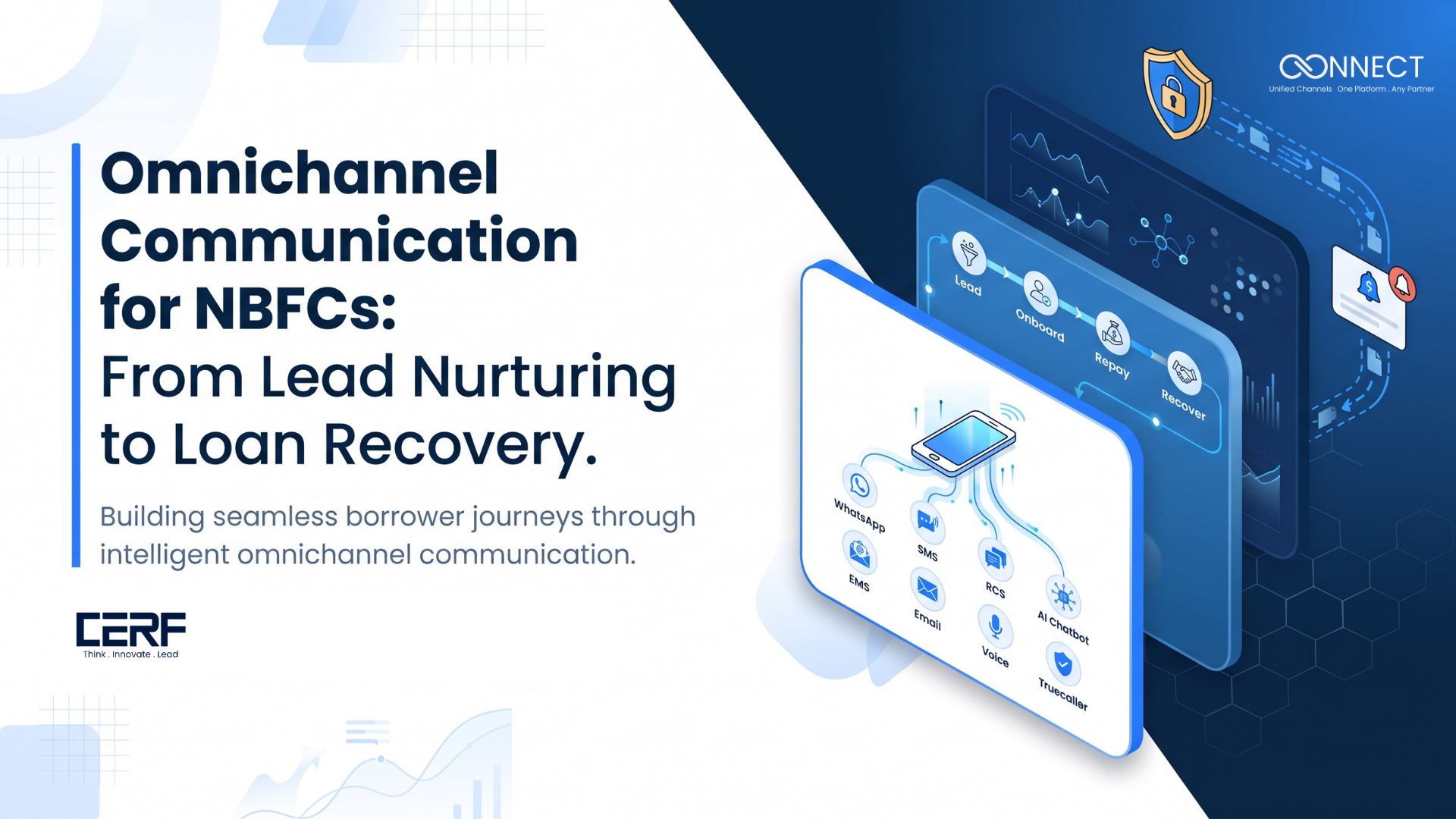
The platform connects SMS, WhatsApp, RCS, Email, Voice, Chatbot, and Truecaller Verified — with 10,000 TPS capacity and a 99.95% uptime commitment. It’s ISO 27001:2022 and SOC 2 Type I & II certified. AES-256 encryption, full audit trails, DC/DR — compliance is in the foundation, not the brochure.
One thing worth calling out specifically for NBFCs: Truecaller Verified. In recovery, caller identity is everything. An unknown number doesn’t get picked up — that’s just reality. A Truecaller-verified call showing your brand name and a transaction context? It gets answered. For a delinquent portfolio, that contact rate difference alone is significant.
The question CERF kept asking while building this was simple: What would it take for an NBFC to never lose a borrower because of a communication failure?
CERFConnect is the answer they built.
Copyright @2025 CERF Solutions Pvt Ltd. All Rights Reserved. Terms and Conditions | Privacy Policy
 QR
QR