
Every chatbot promises seamless service until the moment it matters. A customer asks something the bot can’t answer, the bot loops back with “I’m sorry, I didn’t understand that,” and the customer starts typing in all caps. That’s the handoff problem, and it’s the single biggest reason people distrust automated support.
The irony is that most BFSI and fintech brands didn’t build broken bots on purpose. They built bots that were great at FAQs and terrible at everything after the FAQ ends. The handoff to a human agent — the part that should feel like picking up a phone mid-call — instead feels like starting over. The customer repeats their issue. The context is gone. The agent has no idea what the bot already tried. Nobody’s happy, least of all the customer holding a loan query or a failed transaction that needs a real person, now.
Why it keeps happening
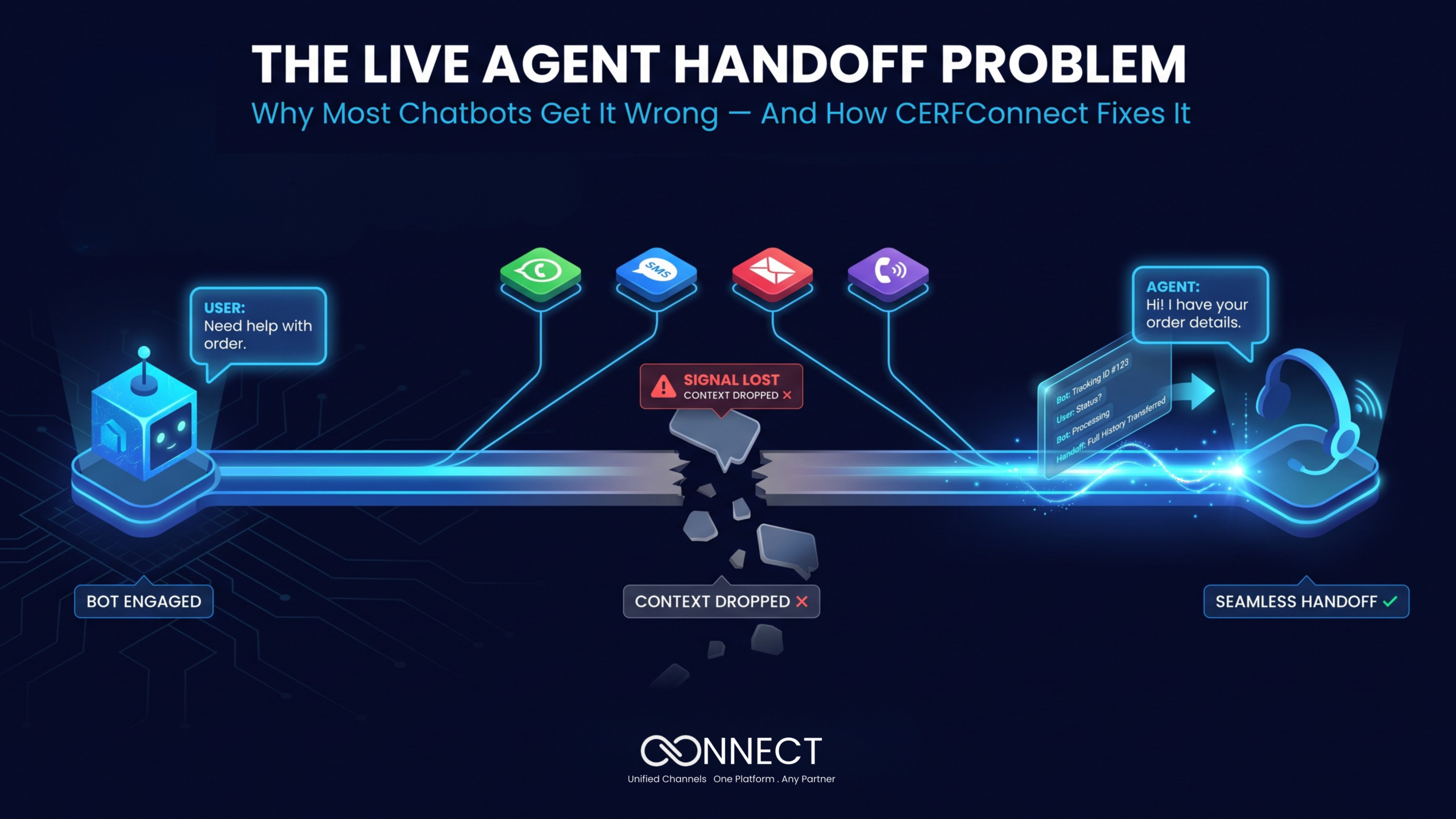
Most chatbot deployments treat the bot and the human agent as two separate systems that happen to share a chat window. The bot lives in its own silo — scripted flows, canned responses, maybe some NLP bolted on. The agent desk lives in another — a CRM, a ticketing tool, a different login. When the bot fails, there’s no clean bridge between the two. What gets handed off is the raw transcript, if anything at all. There’s no case history, no channel continuity, no sense of urgency flagged.
For financial services specifically, this is more than an inconvenience. A customer trying to dispute a transaction or resolve a KYC block doesn’t want to explain their problem twice. Every extra repetition is a trust tax — and in BFSI, trust is the entire product.
What getting the handoff right looks like
A real handoff isn’t a bot admitting defeat. It’s a system that knows when to step back, and hands over everything it has: the conversation so far, the channel the customer is on, what they were trying to do, and what already didn’t work. The human agent should be able to pick up mid-sentence, not mid-investigation.
That requires three things most chatbot setups don’t have: a shared brain between bot and agent, routing logic that decides when a handoff should happen before the customer gets frustrated enough to demand one, and channel continuity — so a WhatsApp conversation stays a WhatsApp conversation instead of forcing a customer onto email or a call.
Where CERFConnect comes in
This is exactly the gap CERFConnect is built to close. CERFConnect’s AI-powered bots aren’t a separate layer sitting on top of the platform — they’re native to it, which means the handoff to a live agent happens inside the same conversation thread, on the same channel, with the full context intact. No repeating yourself, no cold start for the agent.
Intelligent routing does the deciding — failover rules and load balancing mean a query doesn’t just get dumped on the nearest available agent, it gets routed based on what the conversation needs. And because CERFConnect unifies WhatsApp, RCS, SMS, Email, Voice, and IVR into one dashboard, the handoff doesn’t force a channel switch either. If the conversation started on WhatsApp, it stays on WhatsApp — bot and agent both work from the same thread.
CERF built CERFConnect because it’s been on the other side of enough support escalations to know that “AI-powered” means nothing if a bot can’t gracefully admit it’s out of its depth. CERFConnect manages that moment — the bot-to-human transition — as a designed part of the platform, not an afterthought bolted onto a chatbot.
Conclusion
Chatbots don’t fail because they can’t answer every question. They fail because they don’t know how to lose gracefully. The handoff moment is where automation either earns trust or burns it — and for BFSI and fintech brands, there’s no room to burn it twice. CERFConnect treats that handoff as core infrastructure, not a fallback screen — the difference between a bot that frustrates customers and one that quietly makes their day easier.
Copyright @2025 CERF Solutions Pvt Ltd. All Rights Reserved. Terms and Conditions | Privacy Policy
 QR
QR