
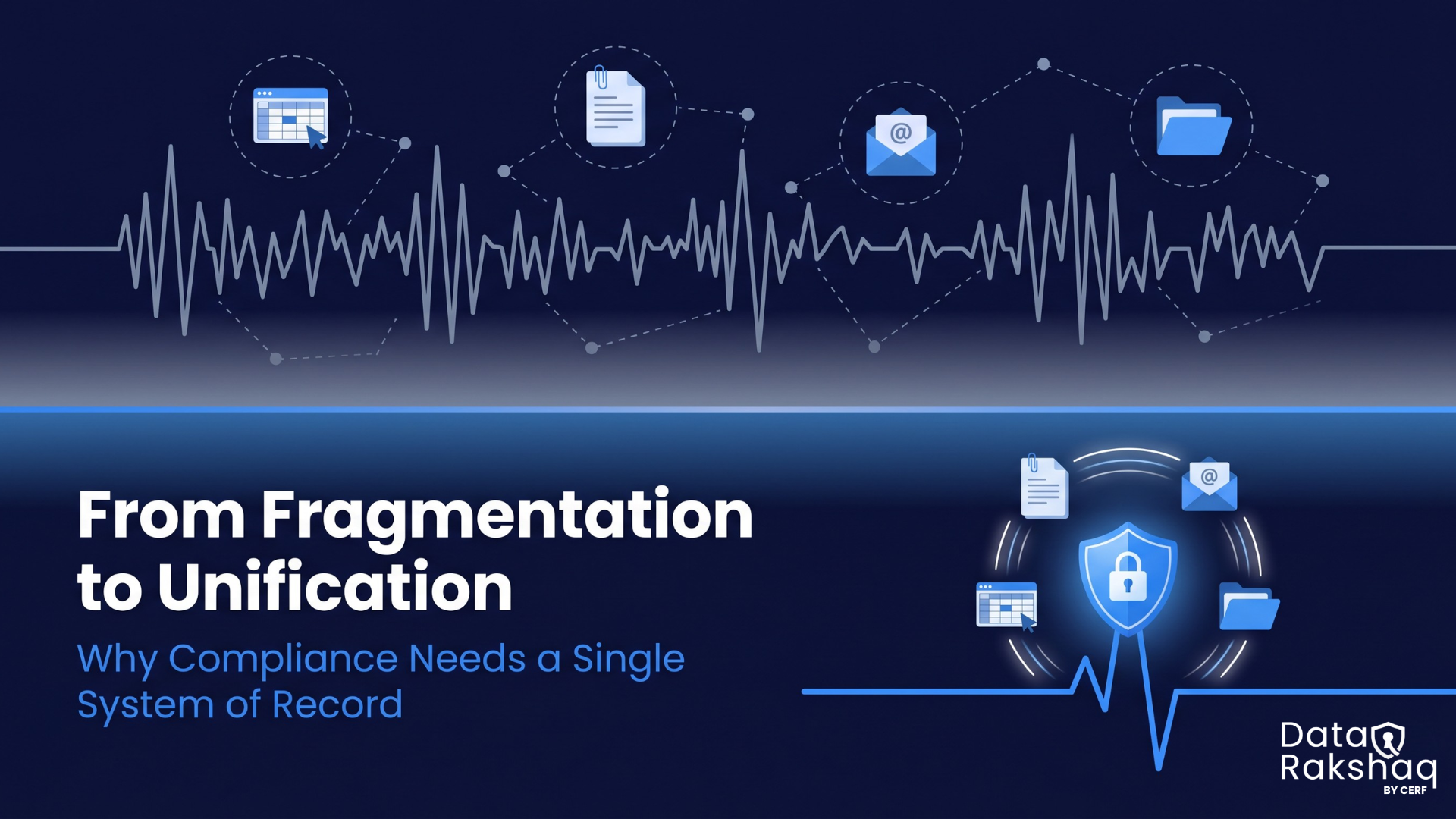
Talk to anyone running compliance at an NBFC or fintech and you’ll hear some version of the same story. Consent data sitting in a spreadsheet. Breach notification templates saved as Word files on somebody’s laptop. Vendor agreements buried in email threads nobody can search properly. A RoPA that hasn’t been touched in over a year, if it even exists.
Here’s the thing — everyone knows roughly where all this stuff lives. But ask someone to pull the whole picture together, and suddenly it’s a full day’s work, not five minutes. That gap is the real risk hiding underneath the DPDP Act 2023. It’s not that compliance work isn’t happening. It’s that it’s happening in pieces that don’t talk to each other. And pieces don’t hold up well when a regulator asks a direct question.
Why 72 hours feels like nothing
Picture this: a DPBI inquiry lands, and the board has 72 hours to respond. Not with promises. Not with a policy PDF. With actual proof — consent records, a list of processing activities, breach logs, DSAR response times. Now imagine that evidence is spread across five different tools that don’t sync with each other. Those 72 hours stop being about responding to the regulator and start being about a scavenger hunt through your own systems.
When a vendor’s mistake becomes the board’s problem
This same fragmentation shows up again with vendors. Section 8(2) of the DPDP Act is pretty blunt about it — if a DSA or vendor has a breach, that’s not something you get to shrug off. It lands squarely with the Significant Data Fiduciary. So if vendor oversight sits in a totally separate system from your breach workflow, your consent ledger, and your RoPA, you don’t really have a compliance program. You have a bunch of documents that happen to be compliance-flavored.
A Word document is not a compliance plan
Here’s an uncomfortable truth: a manual, Word-doc-based compliance plan won’t survive a real DPBI inspection. Not because it’s poorly written — but because a document isn’t proof that a system is actually running. Regulators aren’t asking whether you have a policy. They’re asking whether you can show, right now, what happened and when.
What actually changes when everything’s unified
A single system of record isn’t just a prettier interface bolted onto the same old fragmented tools. It genuinely changes what’s operationally possible.
Two clocks, one incident
DPDP compliance isn’t a one-clock job. There’s the 72-hour DPBI window running alongside a 6-hour CERT-In window — at the same time. Try tracking those separately across separate tools, and you will eventually miss one, because the moment a breach happens is exactly the wrong moment to be cross-checking timelines between systems. A unified platform runs both clocks against the same incident, automatically, so nobody’s doing that math under pressure.
Consent that can actually back itself up
A tamper-proof, SHA-256-secured consent ledger only means something if every single consent event — SMS, app, web, anything coming through a DSA — lands in that same ledger. Split consent tracking across different channels and tools, and “tamper-proof” becomes a nice phrase with nothing behind it. You can’t prove what you never consolidated in the first place.
The RoPA as a living map, not a filing exercise
For BFSI especially, a Record of Processing Activities isn’t paperwork — it’s the map regulators use to see exactly how your organization touches personal data across lending, collections, KYC, and third-party servicing. A pre-loaded library of BFSI-specific processing activities means that map exists from day one, instead of getting reverse-engineered months into an audit.
Where DataRakshaQ comes in
This is exactly the gap DataRakshaQ was built to close. It’s not a generic GRC tool with a DPDP checkbox added on — it’s built for this Act specifically, with BFSI’s regulatory reality baked in from the ground up.
One record behind every feature
A pre-loaded RoPA library mapped to NBFC and fintech activities. A dual-timer breach engine running DPBI and CERT-In clocks against the same incident, automatically. A tamper-proof consent ledger. A DSAR portal with 7-day SLA enforcement built in. A board report that takes seconds because there’s nothing left to piece together.
What actually makes the difference isn’t a longer feature list than every other tool out there. It’s that all of those features pull from the exact same underlying record. A DSAR isn’t a form floating on its own — it’s tied to the same consent history, the same RoPA, the same audit trail that a DPBI evidence pack or board report draws from. That’s the real reason a 90-second evidence pack is possible. Not speed for speed’s sake — the evidence was simply never scattered in the first place.
Built for Indian BFSI — not retrofitted for it
This also reflects how CERF Global Services approaches its whole product suite: not adapting Western compliance tools to fit Indian regulation after the fact, but starting with RBI, CERT-In, and DPBI requirements from day one.
CERF’s take on all this
Here’s how we see it at CERF: DPDP compliance isn’t a checkbox exercise you layer on top of what already exists. It’s an architecture problem. Most of the compliance failures we run into at NBFCs and fintechs aren’t failures of intent — teams know exactly what the law wants. What actually breaks is the connection between that intent and day-to-day operations.
Our take is straightforward — if pulling together your compliance evidence takes more than a few minutes, your system is already fragmented, whether you’ve felt the consequences yet or not. That’s the whole thinking behind DataRakshaQ. Not another dashboard added to the pile, but the whole pile collapsed into one system that can actually defend itself. It’s also why we don’t treat DPDP tooling as an add-on to global compliance software. RBI’s expectations, CERT-In’s clock, and the DPBI’s evidence bar are the starting point, not something we patch in later.
We’d rather NBFCs and fintechs put their energy into growth and customer trust, not into reconciling five spreadsheets the night before an inspection. That’s the outcome we build toward, and it’s the filter every DataRakshaQ feature has to pass through.
The bottom line
The DPDP Act 2023 didn’t invent the fragmentation problem — it just took away the option of ignoring it. Every compliance head at an NBFC or fintech already knows what scattered systems cost: hours lost before every audit, constant uncertainty about what’s actually current, and that gap between what the policy says and what the team can actually prove when it counts.
The organizations that walk into DPBI inspections calmly aren’t the ones with the thickest binders. They’re the ones who can open one system and show, in minutes, exactly what happened, when, and under what consent. That’s what DataRakshaQ is built for — turning DPDP compliance from a pile of documents into one system that can speak for itself. For BFSI and fintech teams figuring out what “audit-ready” should actually mean in 2026, that’s really the whole point.
Copyright @2025 CERF Solutions Pvt Ltd. All Rights Reserved. Terms and Conditions | Privacy Policy
 QR
QR