
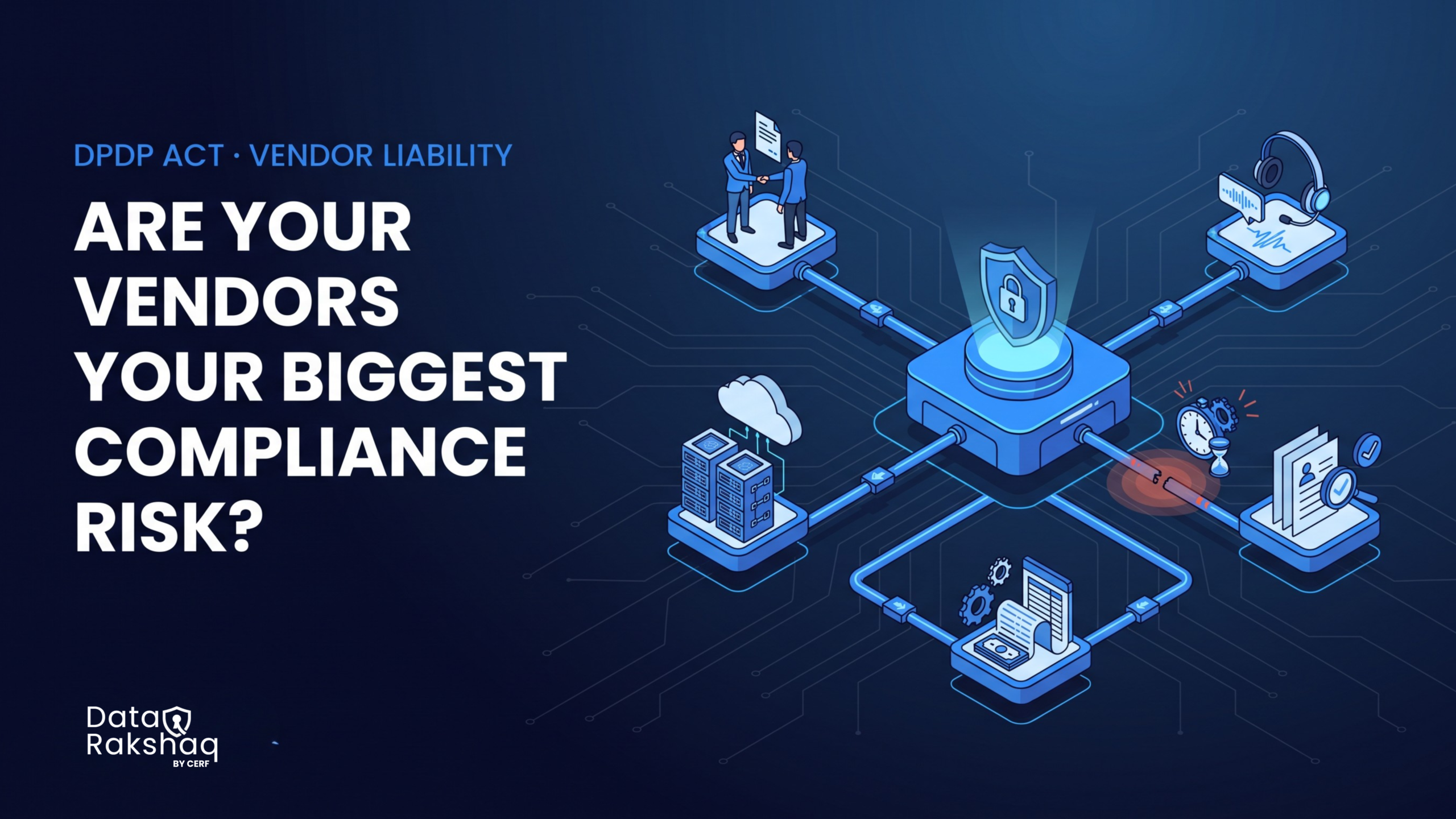
Every BFSI and fintech company relies on outside partners. DSAs bring in new customers. Collection agencies chase overdue accounts. Cloud vendors store customer data. Marketing platforms send offers on your behalf. KYC vendors verify identities. Call centers handle support tickets full of sensitive financial data.
This is normal. No one builds every function in-house anymore.
But under the DPDP Act 2023, this vendor web is exactly where institutions are about to get burned. Most boards haven’t connected the dots yet. This is where DataRakshaQ comes in.
The Liability Doesn’t Transfer. Only the Work Does.
Here’s what most board discussions miss: outsourcing the work doesn’t outsource the liability.
Section 8(2) of the DPDP Act makes this explicit. If your DSA, your collections partner, or any third-party processor mishandles personal data, your institution is still on the hook. Not the vendor. You.
A vendor contract clause that says “vendors are responsible for data protection” won’t hold up. The law puts accountability on you, no matter what your contracts say. Vendors can be sued or dropped. But your institution absorbs the regulatory consequence first.
This Isn’t Hypothetical
A vendor breach with no processor controls in place is exactly what triggers S.8(2) liability. It’s more common than most compliance teams admit.
How many DSAs have access to customer data with zero logging of what they’ve viewed or downloaded? How many collection agencies are working off spreadsheets that were never meant to leave your systems?
And once a breach happens, the clock starts. CERT-In rules require reporting within 6 hours of discovery. Six hours.
Most institutions don’t even discover a breach within that window. By the time they understand what happened, the deadline has already passed.
A Quick, Honest Self-Check
Answer these honestly, not aspirationally:
Do you know exactly which vendors touch customer data, and exactly what each one can do with it?
If a vendor had a breach tomorrow, could your team produce signed agreements, consent trails, and access logs within hours? Or would it take days?
Would your current setup — Word documents, email chains, a shared drive — survive a DPBI inspection?
If you answered “no” or “not sure” to any of these, that’s not a small gap. It’s the exact gap regulators are trained to look for. And boards are the ones left explaining it.
How DataRakshaQ Closes the Gap
This is the blind spot DataRakshaQ was built to remove. Instead of chasing vendor compliance across spreadsheets and email threads, DataRakshaQ gives BFSI and NBFC teams one system of record. Here’s what that includes:
A dual-timer breach system. It tracks the 72-hour DPBI window and the 6-hour CERT-In deadline at the same time, automatically. No manual math under pressure.
A tamper-proof consent ledger, secured with SHA-256. Every consent — even from DSAs or call center partners — is logged, time-stamped, and impossible to alter after the fact.
A pre-loaded BFSI RoPA library covering 45 processing activities, built around how NBFCs and fintechs actually operate.
DPBI-ready evidence packs, generated in 90 seconds. No scrambling to reconstruct a paper trail across six systems.
A one-click board report, so boards get real visibility into vendor risk without becoming compliance experts themselves.
Built-in RBI and DPDP overlap, so DataRakshaQ treats these two regulatory worlds as connected — not as separate boxes to check.
Why This Matters Beyond the Fine
The maximum penalty for an S.8(2) violation runs up to ₹250 crore. That’s significant. But the fine is rarely the real cost.
The real cost is what comes after: regulatory scrutiny, erosion of customer trust, and a board that has to explain publicly why vendor risk wasn’t being watched.
Generic GRC tools aren’t built for DPDP’s timelines or BFSI’s regulatory overlap with the RBI. They’re built broad and adaptable — which sounds good in a pitch but means none of the DPDP-specific urgency is actually there.
DataRakshaQ was built the opposite way: narrow, specific, and designed around the exact deadlines BFSI and NBFC institutions face right now.
The Bottom Line
Vendor relationships aren’t going away. DSAs, collection agencies, and cloud partners are how BFSI and fintech institutions scale. No one is bringing all of that in-house.
But the liability for what those vendors do with your data isn’t going away either. A shared drive and good intentions won’t cut it anymore.
The institutions that get ahead of this will treat vendor oversight as a system — monitored, logged, audit-ready — instead of a scramble after something’s already gone wrong.
CERF and DataRakshaQ take institutions from gap assessment to DPBI-inspection readiness in 16 weeks. Not 16 months.
The question isn’t whether your vendors will eventually be scrutinized. It’s whether you’ll have the evidence ready when that day comes — or whether you’ll be the board explaining why you didn’t.
Copyright @2025 CERF Solutions Pvt Ltd. All Rights Reserved. Terms and Conditions | Privacy Policy
 QR
QR