
Let’s be honest about how most BFSI companies have treated compliance for years. It’s been a cost center. Something legal and IT handle quietly in the background — a budget line nobody wants to justify to the CFO, and not something anyone connects to growth. Compliance was the department that said no, the team that slowed down launches, the line item that showed up in board decks only when something went wrong.
That thinking doesn’t hold up anymore. Not under the DPDP Act 2023. And not without a platform like DataRakshaQ built to keep up with it.
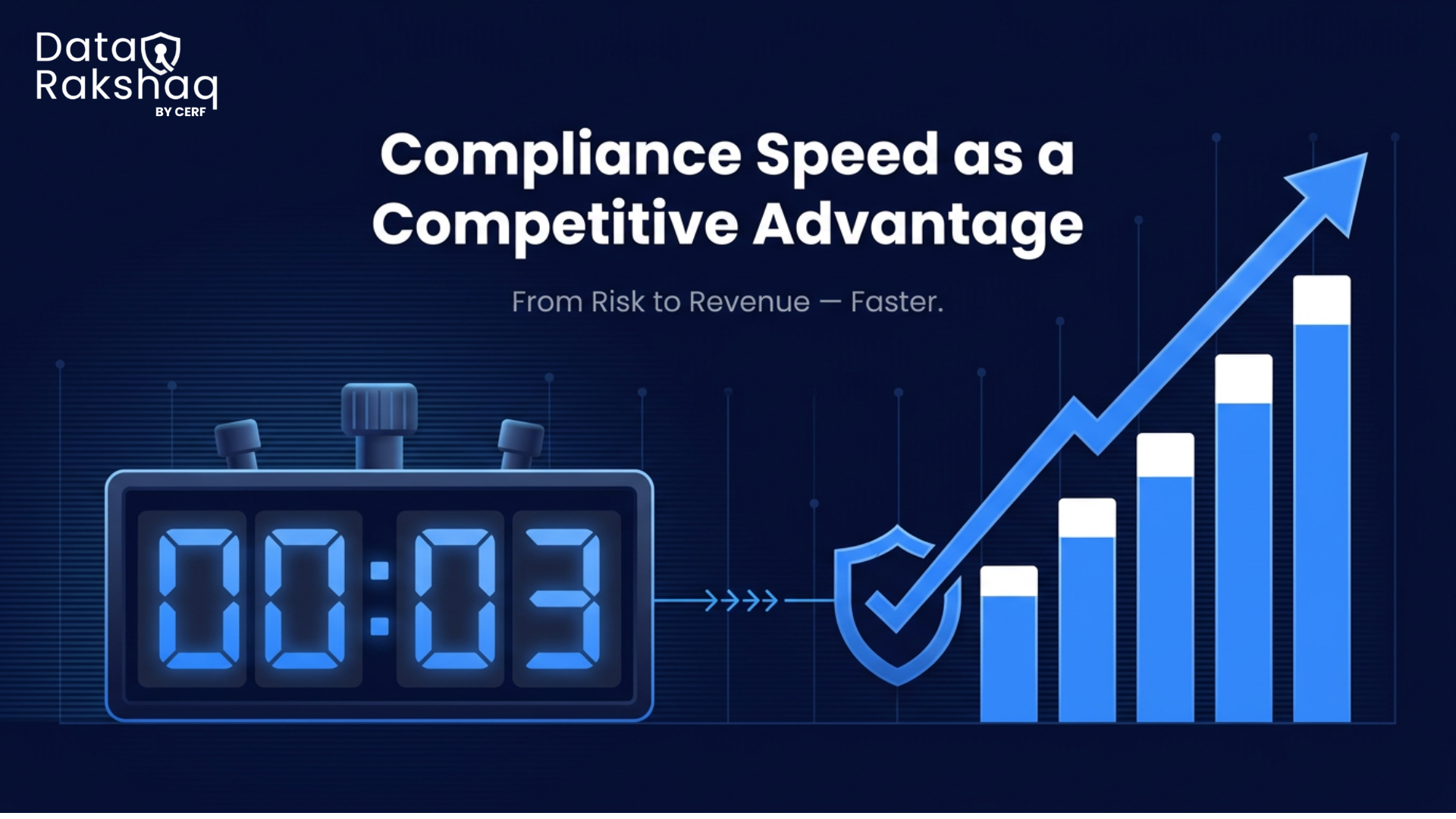
Compliance today has turned into something else entirely: a speed game. How fast you can move when it matters is starting to decide who scales with confidence and who spends every week bracing for the next data request, the next complaint, the next breach notice. Companies that still think of compliance as paperwork are going to find out the hard way that the DPDP Act doesn’t care about intentions. It cares about response time. This is exactly the gap DataRakshaQ was designed to close.
Speed Is the Real Currency Now
Look at what’s on the line today, because none of this is theoretical anymore.
One bulk SMS sent without proper DPDP consent can trigger a Section 6 violation, with penalties up to 250 crore rupees. That’s not a warning letter. That’s a number that shows up in a board meeting and changes careers.
Once the Data Protection Board receives a complaint, you get 72 hours to hand over your RoPA and your consent trail. No extensions. No “let us get back to you next week.” No time to dig through old email threads to reconstruct what happened. If it’s not documented and ready, it doesn’t exist as far as the regulator is concerned.
If a vendor or DSA has a breach and you never put processor controls in place, that’s a Section 8(2) liability sitting squarely on your shoulders, not theirs. CERT-In wants to know within 6 hours. That’s barely enough time to confirm what happened internally, let alone draft a regulatory notification.
And that Word document everyone’s been quietly calling a “compliance plan” for the last few years? It will not survive a DPBI inspection. It never was built to. Boards are now personally liable when it falls apart under scrutiny — which means this isn’t just a compliance team’s problem anymore. It’s a leadership problem, and it moves at leadership speed, or it doesn’t move at all.
See the pattern? Every one of these situations is a clock running out. Nothing gives you the luxury of “we’ll figure it out.” Companies that can pull up evidence, respond fast, and show they’re in control within hours — not weeks — aren’t just avoiding fines. They’re quietly building a reputation. And in an industry where trust is basically the entire product, that reputation compounds. It shows up as faster partner onboarding, smoother audits, and fewer deals stuck in limbo because someone on the other side got nervous about how you handle data.
Stop Treating Compliance as Overhead
Here’s the mindset shift BFSI leaders need to make, and it’s bigger than it sounds. Compliance speed isn’t overhead. It’s infrastructure that lets you grow faster — the same way a good payments stack or a solid core banking system is infrastructure. Nobody calls those a cost center anymore, and compliance shouldn’t be treated any differently. Platforms like DataRakshaQ are what make that shift possible.
Think about what happens when an NBFC can hand over a DPBI-ready evidence pack in minutes instead of weeks. Funding due diligence stops dragging. Partner integrations stop stalling on data-handling questions. Audits stop being a month-long fire drill that pulls half the company off their real jobs. Speed here isn’t just a legal safety net. It’s something you can genuinely sell — a reason investors and partners choose you over the NBFC down the street still managing this in spreadsheets.
Where DataRakshaQ Comes In
This is the exact gap DataRakshaQ was built to close. It’s CERF’s compliance platform, built specifically around the DPDP Act 2023 — not a generic GRC tool with an India-shaped patch bolted on after the fact. That distinction matters more than it sounds, because generic tools force you to translate your obligations into their framework. DataRakshaQ starts with the framework you’re already required to follow.
Here’s what that looks like once DataRakshaQ is in front of a compliance team:
Generic GRC tools simply don’t come with any of this out of the box. DataRakshaQ does, because it was built for exactly this intersection — Indian data law meeting financial services regulation — not adapted for it after the fact once someone realized the gap existed.
The Bottom Line
The BFSI companies that win the next few years won’t be the ones spending the most money on compliance. They’ll be the ones moving through it fastest — speed of evidence, speed of response, speed of reporting. These stopped being back-office metrics a while ago. They show up in investor confidence, partner trust, and how regulators perceive an organization long before any formal inspection happens.
That’s the shift CERF is helping NBFCs and fintechs make with DataRakshaQ — turning DPDP compliance from something teams dread and boards fear into something that genuinely works in the company’s favor. Not eventually. Not after a painful overhaul. One 90-second evidence pack and one 10-second board report at a time.
Copyright @2025 CERF Solutions Pvt Ltd. All Rights Reserved. Terms and Conditions | Privacy Policy
 QR
QR